The soybean harvest represents the most sensitive moment in the entire production system. It is at this stage that the potential built over months of nutritional, phytosanitary and operational management is converted into economic results. However, this is also when some of the biggest losses in the field, often in a silent and underestimated way.
These losses are not just associated with harvester adjustment. They begin much earlier, during the crop cycle, reflecting technical decisions related to nutrition, the quality of applications and the physiological balance of the plant. Identifying them correctly is essential to reduce waste and protect harvest profitability.
Where soybean harvest losses begin
Harvest losses can be classified into natural losses and operational losses. The natural ones are linked to the early opening of pods, lodging and the physiological degradation of the plant when harvesting is delayed. The operational ones occur during the mechanized process, involving platform, trail, separation and cleaning.
A common mistake in the field is to focus all attention on the harvester. Technical studies show that a significant part of the losses occur even before the machine enters the field, especially when there is maturation unevenness e fragility of the pods. These factors are a direct consequence of the management adopted throughout the cycle.
Plant physiology and direct impact on harvest
Physiologically balanced soybean plants have more resistant pods, well-formed grains and architecture suitable for cutting and threshing. When the crop goes through successive stresses, such as nutritional deficiency, phytotoxicity or application failures, structural weakening of the plant occurs.
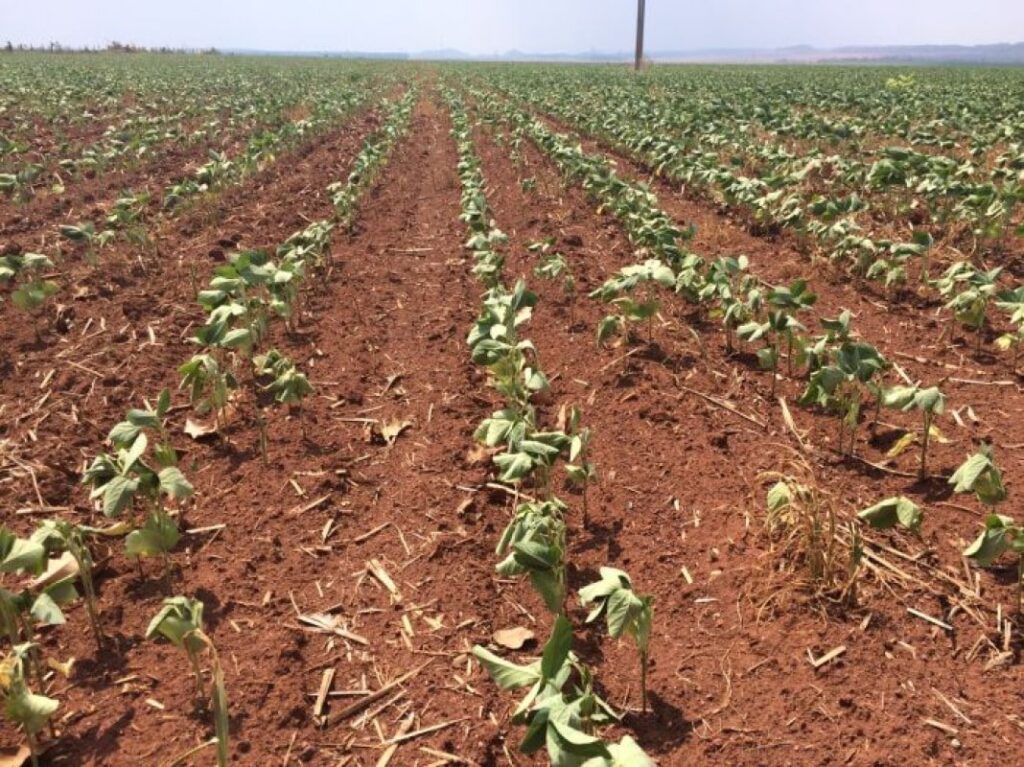
This weakening increases susceptibility to natural threshing, increases losses before harvesting and makes it difficult to optimally adjust the machine. Furthermore, uneven plants force the producer to choose between harvesting areas that are still green or waiting too long, increasing losses due to pod opening.
Common errors observed in the field
Among the most frequent errors related to losses in the soybean harvest, the following stand out:
- Applications carried out without considering suitable climatic conditions.
- Inadequate use or absence of adjuvants, reducing the efficiency of the syrup.
- Nutritional unevenness throughout the cycle.
- Delay in harvesting in an attempt to gain grain weight.
In isolation, these errors seem small, but together they can represent losses of several bags per hectare.
How correct management reduces harvest losses
Reducing harvest losses starts long before the moment of operation. Well-managed management throughout the cycle guarantees more balanced plants, more resistant pods and greater tolerance to climatic variations in the final period.
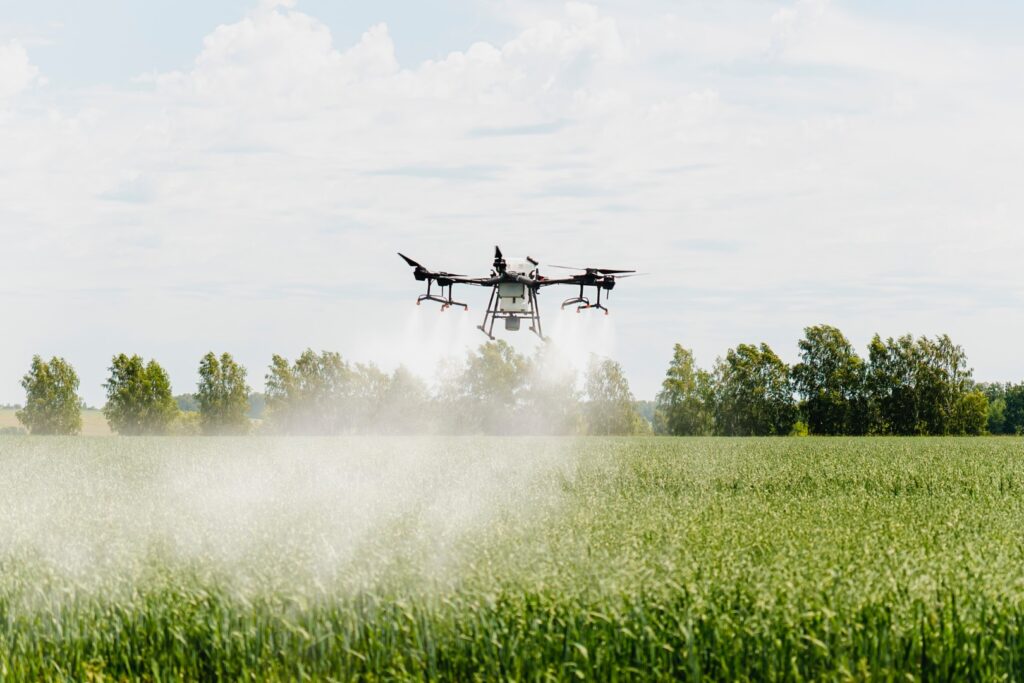
In this context, the application quality assumes a central role. Suitable agricultural adjuvants improve coverage, deposition and absorption of products, reducing failures that compromise the physiological performance of the plant.
Route solutions applied to harvest management
O Route-N works by improving the efficiency of the syrup, reducing losses due to evaporation and runoff, while the Route-VIP contributes to better spreading and adhesion, ensuring more uniform coverage even in a closed canopy. These solutions enhance management and help build crops that are more prepared for efficient harvesting.
The soybean harvest is a direct reflection of all the decisions made throughout the cycle. Invisible losses exist, are recurring and directly impact the final result. Investing in technical management and application quality is the most efficient way to protect the built productive potential.
👉 Speak to a Route technical consultant and request a complete diagnosis of your harvest management.
👉 Assess where your crop may be losing productivity.
References
BRAZILIAN AGRICULTURAL RESEARCH COMPANY. Soy production technology. Brasília: Embrapa, 2023.
BRAZILIAN AGRICULTURAL RESEARCH COMPANY. Losses in mechanized grain harvesting. Londrina: Embrapa Soja, 2021.